Easy Crochet Doily Coaster from Scrap Yarn: A Beginner Guide
Learn how to make a crochet doily coaster from scrap yarn. Beginner-friendly steps, cotton yarn tips, and fixes for ruffling, cupping, and blocking.

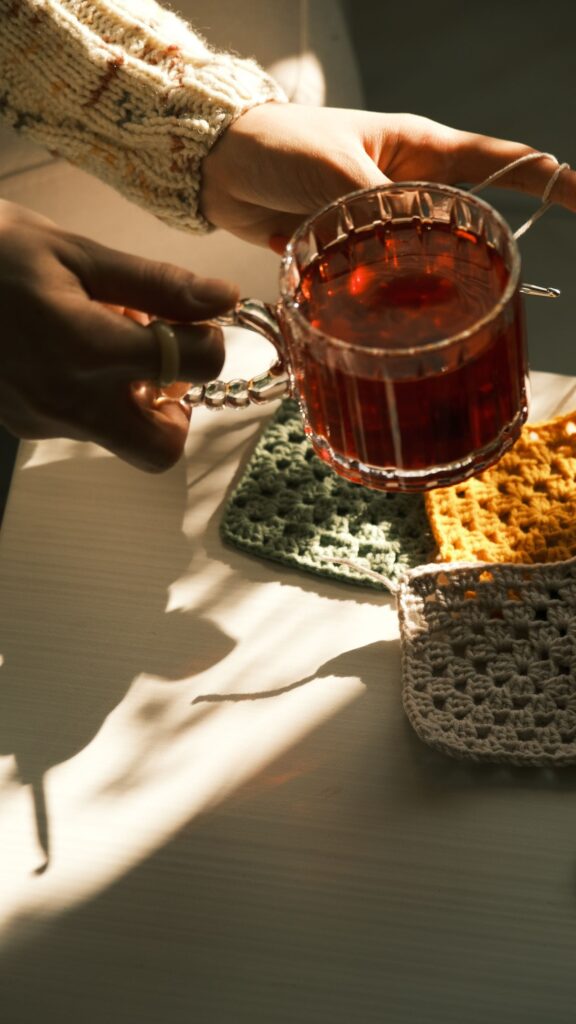
Every crocheter I know has a bag of leftover yarn they feel guilty about. Half a skein of blue, a tangle of cream, a few yards of something that seemed like a good idea in the store. I used to stuff mine in a bin and ignore it. Then I discovered coasters, and that bin finally started to feel useful.
Jump to section
A crochet doily coaster is small, fast, and forgiving. You can finish one in an evening, and if it goes wonky, you have lost a few yards of yarn instead of a weekend. It is also a gentle way to learn how working in the round actually behaves.
In this post I will walk you through how a doily-style round coaster comes together, what yarn to grab, how to keep it flat, and the mistakes I made so you do not have to. If you would like to watch someone stitch one, Caylene’s tutorial below is a friendly place to start.

Why coasters are the perfect scrap-yarn project
A coaster only needs about 20 to 40 yards of yarn, so almost any leftover works. That means you can practice without buying anything new. Because the piece is so small, you see results fast, and that quick win keeps beginners motivated.
Coasters are also a great first project in the round. Nothing has to fit a head or a hand, so a slightly off stitch count is not a disaster. You learn to read your rounds, spot where each one starts, and see how increases shape a flat circle. Those skills carry straight into bigger projects like granny squares.
Materials you need
- Yarn: scraps of worsted or DK weight, ideally 100 percent cotton.
- Hook: a size H-8 (5 mm) is a good start with worsted cotton. Go down one size if your fabric looks loose.
- Scissors and a yarn needle for weaving in ends.
- Stitch marker (a scrap of contrasting yarn works fine).
Why cotton is best for coasters
Cotton absorbs moisture, holds its shape, and can go in the wash. Acrylic tends to repel water, so a sweaty glass just leaves a puddle. Cotton also has less stretch, which helps your circle stay flat instead of curling. If all you have is acrylic scraps, use them for decorative mats and save the cotton for the ones that will hold drinks.
The stitches you will use
This project uses only a handful of basics. Here are the US abbreviations, explained once:
- ch = chain
- sl st = slip stitch
- sc = single crochet
- dc = double crochet
- ch-sp = chain space, the gap made by a chain
You will also start with a magic ring (also called a magic circle), which lets you pull the center tight so there is no hole. If the magic ring frustrates you, chain 4 and join with a sl st to form a small ring instead. It works just as well.
How a doily-style coaster is built
Most round coasters follow the same simple logic. Exact counts vary from pattern to pattern, so treat this as the map rather than the recipe.
- Center: make a magic ring and work a round of dc stitches into it, then pull it closed and join with a sl st.
- Increase round: work two stitches into each stitch (or into each chain space) so the circle grows outward evenly.
- Chain-space round: alternate a stitch with a short chain, skipping stitches underneath. These chain spaces give the doily its lacy look.
- Scallop edge: in each chain space, work a small group of dc stitches, then sl st between groups. Each group becomes a little petal.
The rhythm is what matters. Increases happen at the same spots every round, so the fabric grows in a circle instead of a hexagon or a blob. Mark the first stitch of each round so you always know where you are.
Keeping it flat
Two things go wrong with round projects, and both come down to stitch count.
- Ruffling (waves at the edge): you added too many stitches. Recount, and if the count is right, try a hook one size smaller or work a slightly shorter stitch.
- Cupping (a bowl shape): you added too few. Make sure every increase round really grows as the pattern says.
Do not be afraid to rip back a round. It takes two minutes and saves you from a coaster that never sits right. Tension also matters: if you are gripping the yarn hard, the fabric puckers. Relax your hands and let the stitches breathe.
Blocking your coaster
Blocking sounds fancy, but here it just means shaping the finished piece. Dampen the coaster with a spray bottle or a quick soak, press out extra water in a towel, then pin it flat into a neat circle, tugging each scallop into place. Let it dry fully. Cotton holds the shape well, and a light block often fixes a mild curl and makes those petals look crisp. If you enjoy detail like this, you might also like textured crochet patterns for your next small project.
Gift and set ideas
- A set of four in matching scrap colors, tied with a scrap of twine.
- A rainbow set where each coaster uses a different leftover color.
- A holiday mix: cream and red for winter, pastels for spring.
- Pair them with a mug and a tea bag for an easy housewarming gift.
- Make a bigger version as a mat under a plant or candle.
Once you have the hang of it, try scaling up the same pattern with an extra round or two. A larger circle makes a lovely table topper, and small crocheted pieces like this pair nicely with crochet pillow ideas when you are styling a cozy corner.
Common mistakes to avoid
- Losing the round start. Use a stitch marker every single round.
- Skipping the count. Count stitches at the end of each round, especially early on.
- Using stretchy yarn. Fuzzy or very stretchy scraps make edges wavy and hard to block.
- Pulling chains too tight. Tight chain spaces make the scallops bunch up instead of opening.
- Weaving ends poorly. Weave each end in at least a few inches in two directions so it does not pop out after washing.
None of these are permanent. Every coaster teaches you something, and you will have a pile of practice pieces you can actually use.
Frequently asked questions
How much yarn does one crochet doily coaster use?
It depends on your yarn weight and the pattern, but most coasters take a small amount, often well under one ball of worsted cotton. That is why they are ideal for leftovers.
Can I use acrylic yarn for coasters?
You can, and they will look nice, but acrylic does not absorb water well, so it is better for decorative mats. For drink coasters, cotton is the practical choice.
Why is my round coaster ruffling or curling?
Almost always a stitch count problem. Ruffling means too many stitches, cupping means too few. Recount each round, adjust your hook size if needed, and block the finished piece.